
Don’t say I didn’t warn you. Back in 2023 I predicted that in the very near future everything would be riddled with fakery and falsehood. (You can check I’m not lying here) Everything you read, every news bulletin, every video you watch, would be rigged, adjusted, distorted or entirely fabricated in order to sell you a particular narrative. Supercharged by AI, I argued, every official government statement, every news outlet and every social media platform would unleash an onslaught of deceit, cover up and augmented dis-and mis-information the likes of which humanity could never have imagined. But even little ole me, in my most bombastic and hyperbolic splendour did not foresee how fast and furious this sorry prophecy would come true.

No one has been spared. Even the granniest of grannies has begun to wise up. They’ve had to ffs. Every social media post, every celebrity selfie, every video of a dog rescuing its owner, cats cuddling new born chicks, every act of jaw dropping heroism…it’s all faked AI slop, stitched together to hijack a couple of seconds of your attention. Most of the time that’s all they want. You stop scrolling briefly to double check if that car really did fly off that cliff, and that’s the green light. Instantly, the algorithm detectives add it to your personal file under a slew of category headings including ‘likes death-defying stunts’, ‘likes car chases’ as well as the more inclusive ‘keen on ridiculous scenarios of all types’. That innocent microsecond of a manoeuvre is all they need to get to work stoking their gigantic servers with a gazillion snippets of nonsense primed to tease your ravenous dopamine addiction.
And now that the algorithms know what grabs your attention they can create new content, new nonsense following similar patterns, since it’s all AI generated anyway. In the mad matrix we now live in, otherwise known as the attention economy even the likes and comments on social media posts are fake. Some of us were vaguely aware that bots ‘like’ or ‘comment’ on various posts but most of us do not have the foggiest idea of the truly industrial scale of these bots.

So, in order to guarantee the bot’s latest video gets the attention it deserves it will swiftly generate its own audience of bots to like and comment appropriately too. It’s a perfect feedback loop: it makes stuff up, generates it, promotes it, likes it, comments on it…and then because it was so popular, largely with itself, it produces another big bucket of AI slop so that the whole process can start again.
The result of all this bot shenanigans is that no one can tell how many genuine, human likes any content has actually received. Or whether the ‘person’ they responded to is even a real person at all. It seems data analytics are fake too.

On my X feed recently I came across a couple of images of, shall we say, ridiculously fantastical females posing provocatively with the question “What was your first thought when you saw me?.” Unfortunately, I made the fatal mistake of replying “AI”. Oh boy, that was it. I’m now inundated with a daily army of hilariously over-endowed AI women, all of whom are desperate to get to know me, apparently. Certainly keeps me busy.
Bad Shorts & Brainrot
So, exactly how much AI slop is on Youtube, for example? In order to answer that question a widely cited study by video editing company Kapwing analysed the first 500 videos recommended to a brand new YouTube account. Here’s what they found:
21% was classified as AI slop, meaning the videos were low-quality, fully or heavily AI generated content designed to farm views.
33% fell into the broader ‘brainrot’ category ie. mindless, repetitive, low-value content which often includes AI-generated material.
This 21% figure for AI slop in new-user feeds was reported all over the place, including The Guardian, but that doesn’t mean it’s true, of course. But just to be clear, it also doesn’t mean 21% of all videos ever uploaded to YouTube are AI generated but it does show how heavily the recommendation algorithm is pushing this type of content to new viewers.

Meanwhile on X, recent analysis suggests that between 10–15% of total accounts are bot driven, so that’s roughly 40–50 million accounts out there distorting what you thought was the truth. And when it comes to election time, or when other major or controversial events are trending, that figure can easily jump to 45%. So the chances are that the expertly crafted sarcasm you spent all morning perfecting in response to an angry post is nothing but a pointless little ping pong ball bouncing into a pit of fire. Makes you feel hopeless, doesn’t it?
Trust is the biggest issue we face. If the percentage of faked content is increasing month by month how can we trust anything we see any longer? Well, let’s get practical for a minute.
To avoid becoming permanently cynical and giving up altogether, here is my handy trust checklist:
1 Check with other sources, right across the political spectrum for a more balanced view before you get too red faced and angry.
2 Build a network of trusted commentators. There are still some terrific truth-tellers out there, so stick with the ones with a decent track record of getting things right.
3 Listen to long form debate on podcasts etc. rather than reacting to snappy headlines and provocative soundbites.
Ultimately of course, it doesn’t really matter that the video of the Alsatian retrieving a baby from a burning building is fake or not, or whether Tom Cruise really did gatecrash that wedding ceremony in Dagenham. We will quickly become accustomed to assuming that most content is for entertainment purposes only. Most of us probably already have.
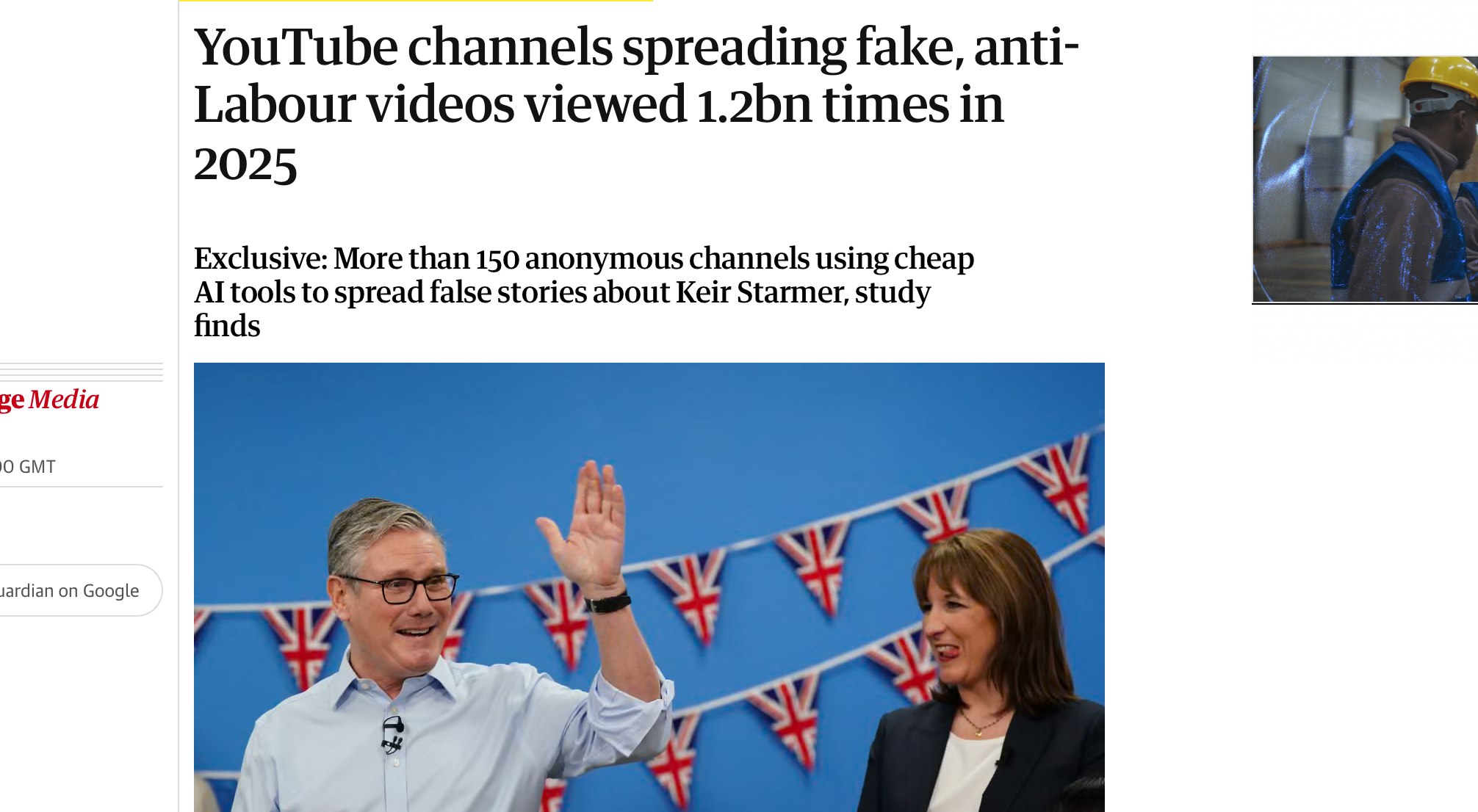
But when it comes to shaping our attitudes, reinforcing our prejudices or influencing our political persuasion, well that’s a different kettle of meatballs altogether. Our job as consumers of ‘information’ is to navigate the deep and choppy waters of utter bullshit that lie ahead. That means when you see a video of Sir Keir Starmer dressed as baby riding a donkey along the Blackpool seafront, it’s probably worth cross checking it with other media sources. If, however, you come across a similar video of Sir Ed Davey there is, of course, no need to check.

Howard Saunders is a writer, speaker and the Retail Futurist
howard@22and5.com
@retailfuturist
