About Howard Saunders

The Retail Futurist, otherwise known as Howard Saunders, is a writer and speaker whose job it is to see beyond retail’s currently choppy waters. Howard spent the first twenty five years of his career at some of London’s most renowned retail design agencies, including Fitch & Company, where he created concepts, strategies and identities for dozens of British high street brands. In 2003 he founded trend-hunting agency, Echochamber, inspiring his clients with new and innovative store designs from across the globe. Howard relocated to New York in 2012 where the energetic regeneration of Brooklyn inspired his book, Brooklynization, published in 2017. His newfound role as champion for retail’s future in our town and city centres gave rise to the title The Retail Futurist. Howard has been interviewed on numerous television and radio programs and podcasts for BBC Radio 4, BBC Scotland, the British Retail Consortium, Sky News Australia and TVNZ, New Zealand. His talks are hi-energy, jargon-free journeys that explore the exciting, if not terrifying, retail landscape that lies ahead. When not in retail mode, Howard has recorded, literally, thousands of digital music masterpieces, most of which remain, thankfully, unheard.

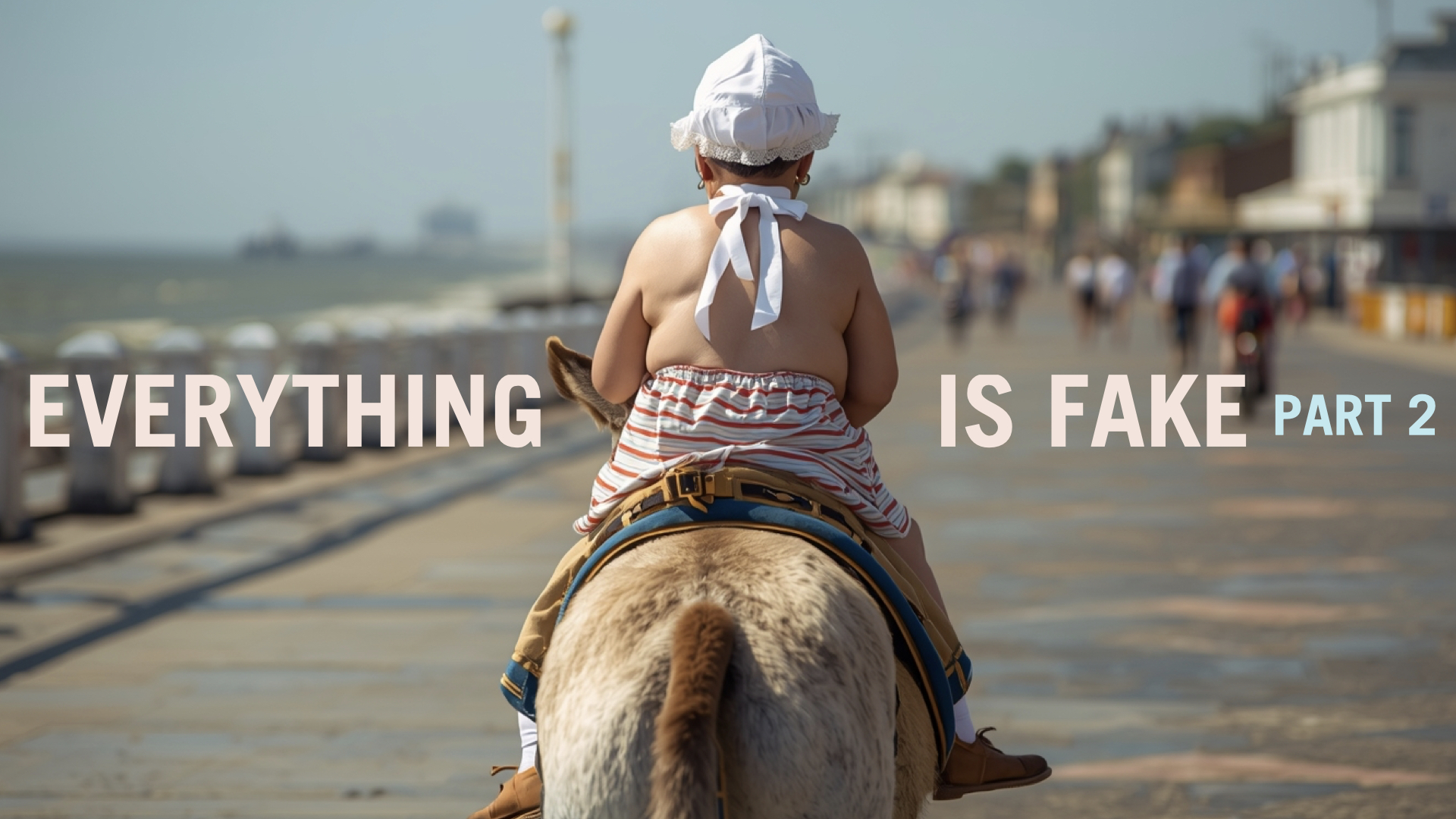
EVERYTHING IS FAKE…PART 2

Don’t say I didn’t warn you. Back in 2023 I predicted that in the very near future everything would be riddled with fakery and falsehood. (You can check I’m not lying here) Everything you read, every news bulletin, every video you watch, would be rigged, adjusted, distorted or entirely fabricated in order to sell you a particular narrative. Supercharged by AI, I argued, every official government statement, every news outlet and every social media platform would unleash an onslaught of deceit, cover up and augmented dis-and mis-information the likes of which humanity could never have imagined. But even little ole me, in my most bombastic and hyperbolic splendour did not foresee how fast and furious this sorry prophecy would come true. 

No one has been spared. Even the granniest of grannies has begun to wise up. They’ve had to ffs. Every social media post, every celebrity selfie, every video of a dog rescuing its owner, cats cuddling new born chicks, every act of jaw dropping heroism…it’s all faked AI slop, stitched together to hijack a couple of seconds of your attention. Most of the time that’s all they want. You stop scrolling briefly to double check if that car really did fly off that cliff, and that’s the green light. Instantly, the algorithm detectives add it to your personal file under a slew of category headings including ‘likes death-defying stunts’, ‘likes car chases’ as well as the more inclusive ‘keen on ridiculous scenarios of all types’. That innocent microsecond of a manoeuvre is all they need to get to work stoking their gigantic servers with a gazillion snippets of nonsense primed to tease your ravenous dopamine addiction.

And now that the algorithms know what grabs your attention they can create new content, new nonsense following similar patterns, since it’s all AI generated anyway. In the mad matrix we now live in, otherwise known as the attention economy even the likes and comments on social media posts are fake. Some of us were vaguely aware that bots ‘like’ or ‘comment’ on various posts but most of us do not have the foggiest idea of the truly industrial scale of these bots.

A Youtube View Farm

So, in order to guarantee the bot’s latest video gets the attention it deserves it will swiftly generate its own audience of bots to like and comment appropriately too. It’s a perfect feedback loop: it makes stuff up, generates it, promotes it, likes it, comments on it…and then because it was so popular, largely with itself, it produces another big bucket of AI slop so that the whole process can start again.

The result of all this bot shenanigans is that no one can tell how many genuine, human likes any content has actually received. Or whether the ‘person’ they responded to is even a real person at all. It seems data analytics are fake too.

Sex sells. Well, it made you read this caption anyway

On my X feed recently I came across a couple of images of, shall we say, ridiculously fantastical females posing provocatively with the question “What was your first thought when you saw me?.” Unfortunately, I made the fatal mistake of replying “AI”. Oh boy, that was it. I’m now inundated with a daily army of hilariously over-endowed AI women, all of whom are desperate to get to know me, apparently. Certainly keeps me busy. 

Bad Shorts & Brainrot

So, exactly how much AI slop is on Youtube, for example? In order to answer that question a widely cited study by video editing company Kapwing analysed the first 500 videos recommended to a brand new YouTube account. Here’s what they found:

21% was classified as AI slop, meaning the videos were low-quality, fully or heavily AI generated content designed to farm views. 

33% fell into the broader ‘brainrot’ category ie. mindless, repetitive, low-value content which often includes AI-generated material. 

This 21% figure for AI slop in new-user feeds was reported all over the place, including The Guardian, but that doesn’t mean it’s true, of course. But just to be clear, it also doesn’t mean 21% of all videos ever uploaded to YouTube are AI generated but it does show how heavily the recommendation algorithm is pushing this type of content to new viewers.

Tom and Brad fight it out to the death in a viral, completely fabricated video

Meanwhile on X, recent analysis suggests that between 10–15% of total accounts are bot driven, so that’s roughly 40–50 million accounts out there distorting what you thought was the truth. And when it comes to election time, or when other major or controversial events are trending, that figure can easily jump to 45%. So the chances are that the expertly crafted sarcasm you spent all morning perfecting in response to an angry post is nothing but a pointless little ping pong ball bouncing into a pit of fire. Makes you feel hopeless, doesn’t it?

Trust is the biggest issue we face. If the percentage of faked content is increasing month by month how can we trust anything we see any longer? Well, let’s get practical for a minute.

To avoid becoming permanently cynical and giving up altogether, here is my handy trust checklist:

1 Check with other sources, right across the political spectrum for a more balanced view before you get too red faced and angry.

2 Build a network of trusted commentators. There are still some terrific truth-tellers out there, so stick with the ones with a decent track record of getting things right. 

3 Listen to long form debate on podcasts etc. rather than reacting to snappy headlines and provocative soundbites.

Ultimately of course, it doesn’t really matter that the video of the Alsatian retrieving a baby from a burning building is fake or not, or whether Tom Cruise really did gatecrash that wedding ceremony in Dagenham. We will quickly become accustomed to assuming that most content is for entertainment purposes only. Most of us probably already have. 

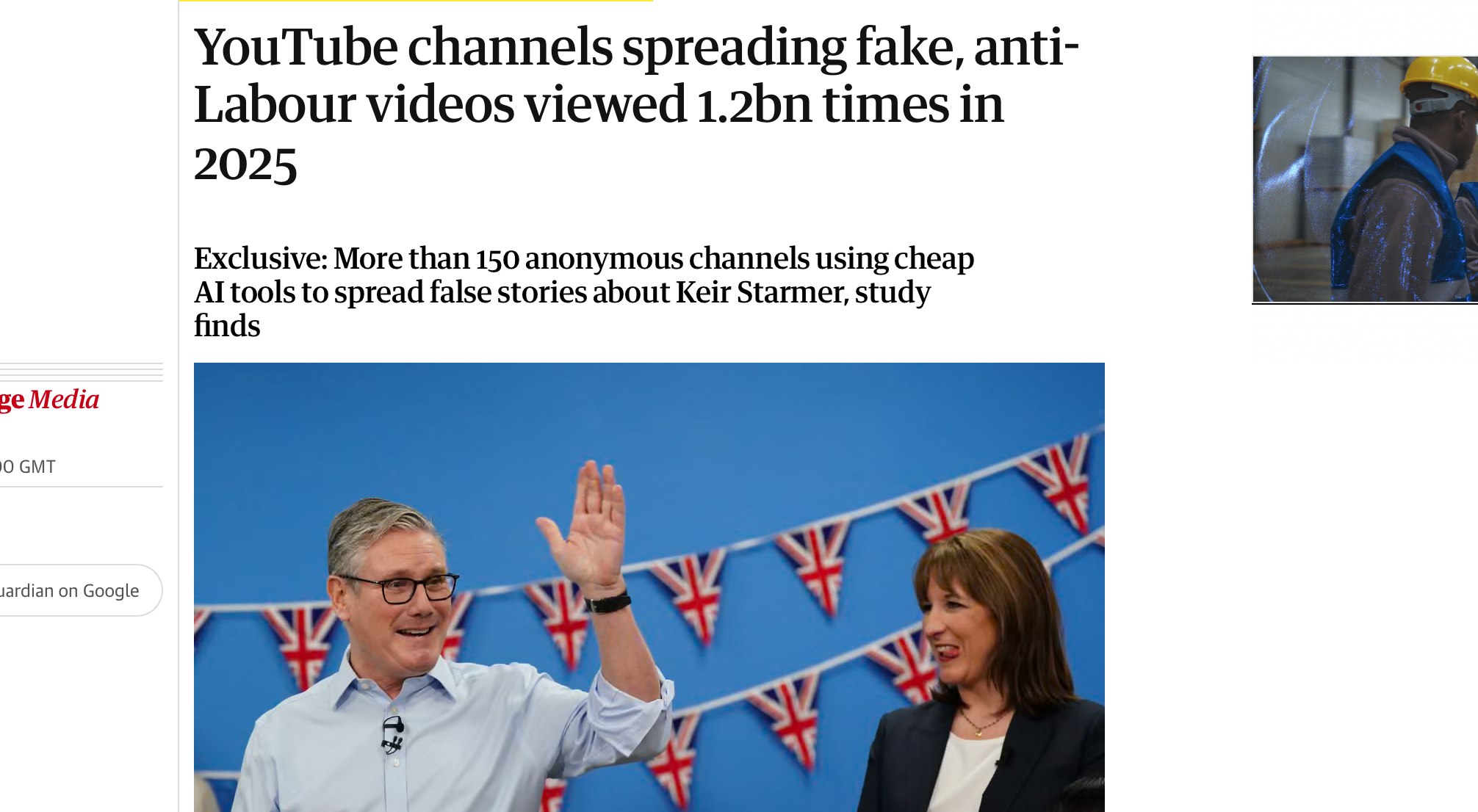
But when it comes to shaping our attitudes, reinforcing our prejudices or influencing our political persuasion, well that’s a different kettle of meatballs altogether. Our job as consumers of ‘information’ is to navigate the deep and choppy waters of utter bullshit that lie ahead. That means when you see a video of Sir Keir Starmer dressed as baby riding a donkey along the Blackpool seafront, it’s probably worth cross checking it with other media sources. If, however, you come across a similar video of Sir Ed Davey there is, of course, no need to check.

Howard Saunders is a writer, speaker and the Retail Futurist

howard@22and5.com

theretailfuturist.com

@retailfuturist

  Howard Saunders   Mar 29, 2026   AI, big data, clickbait, Future, smartphone, Uncategorized   Comments Off on EVERYTHING IS FAKE…PART 2   Read More

A NEW YEAR’S SOB STORY

I’ve only got two friends. Yep, after more than six decades on Planet Earth there are only two adult men that I could call on in an emergency at four in the morning who’d genuinely be willing to help. One of them was the landlord of my local pub. For the sake of this article let’s call him Micky, for that is his actual name. Micky is a particularly kind and gentle soul, shrink-wrapped, paradoxically, in a thousand scary tattoos. A sheep in wolf’s clothing, you might say. Anyway, he gave up his pub a few weeks ago and I don’t blame him. Not only was he the chef, the butcher, the Instagram photographer, the marketing manager, the decorator, the gardener, the bookkeeper and the barman, he was also the HR department and mental health therapist. Anyone who’s been involved in hospitality will know that managing staff can take up most of your time. If Micky wasn’t standing in for the flaky Gen Zedder who called in sick again, he’d be separating two murderous knife wielding commis chefs or having to endure an hour’s tearful tale of micro aggressions behind the bar. Not an easy job. 

Now, take all this and add in the Reeves effect: the doubling of business rates, the increase in the minimum wage, the fiddling with NI thresholds, new recycling taxes, relentless food inflation and the world’s highest energy costs and you have a perfect storm. A storm which, sadly, he couldn’t ride out this time. You see, it’s not just profits that are squeezed, it’s life’s motivation itself. Dedicating your life to an industry, a community and a five hundred year old building, the realisation that there will no longer be any financial return is soul destroying to say the least: knowing there will be no more holidays, no chance of that new kitchen, no hope of replacing the dodgy boiler.

He rang me in tears to apologise for letting us down: ‘us’ being the community, the regulars that rely on him, not for beer, but for moral support, a bit of company, and most importantly, a sense of belonging. All the reasons the British pub was invented for Christ’s sake! And now, thanks to a government that doesn’t understand how the country works, and indeed, despises those that attempt to prosper within it, we have lost him, and a thousand good souls like him.

But the problems run far deeper than hoping Sir Keir does another u-turn. For decades, successive governments have bullied beer like it was the fat kid in the school playground: another couple of pence here, another few pence there, teeny, tiny straws on the back of the poor, moth-eaten camel they’ve always taken for granted. Beer took the brunt because it comes with inbuilt justification: ‘alcohol is bad for you..we’re simply protecting your health’.

As a comparison, if governments had decided for ‘health reasons’ back in say, 1985, to tax our national dish the way beer has been taxed, a portion of fish and chips would currently cost about £18. Precisely. Whether we like it or not, products carry their own price parameters: invisible, yet universally understood. No one would pay twenty quid for a tube of toothpaste. Not because they can’t afford it, but because it’s overstepped its invisible threshold. Likewise, outside the lunacy of London, six or seven pounds for a beer pushes it across the line from a daily reward into a weekly treat. That changes the business model entirely. Governments tax things we can’t easily give up, but the heavier the tax burden the greater the change in our behaviour. Sadly, this is what will seal the pub’s fate.

Beer is a drink to be supped, gulped even, not sipped like wine. But when the price of a pint is not far off a shop bought bottle of red, something has gone badly awry. Inevitably, regular punters have learnt that grabbing a selection of bottled beers from the supermarket instead, can save the best part of fifty quid.

Much like the decision to turn the heating on, the price of a pint of beer was never a factor in whether or not to go to the pub, not even in my poverty stricken student days. Sadly, just like turning on the central heating, it bloody well is now. When they tell us Britain is currently poorer than Mississippi I guess this is what they mean.

And that’s not the worst of it. Five years ago, as we went into lockdown, I predicted the rise of Homo-Trepidatious, a new breed of human that’s distrusting of everything. But it’s much worse than I thought. Today’s youth isn’t drinking, smoking and not having sex because they’re super health conscious, but because they are scared. Turns out, locking kids in their bedrooms for two years has some serious consequences, and the demise of the pub may very well be one of them.

It’s quite clear that governments see our pubs as a glorious network of cash cows that however hard they are milked will keep on giving because they’re central to our way of life. They are wrong. We haven’t just reached the tipping point, I’m afraid we’ve passed it. So the next time you go for a Sunday stroll with the unspoken understanding there’ll be a refreshing pint waiting at the the end of it, you may be disappointed to find that the local you now only use once a week has closed for good.

Oh, and Micky? He’s currently deciding where best to apply his people skills, somewhere that might actually reward him. He’ll be fine.

Cheers to that!

Howard Saunders is a writer, speaker and The Retail Futurist

howard@22and5.com

theretailfuturist.com

@retailfuturist

  Howard Saunders   Jan 13, 2026   Uncategorized   Comments Off on A NEW YEAR’S SOB STORY   Read More